

MGC tick value: $1 per tick on 10-ounce Micro Gold futures
One MGC tick is $0.10 per troy ounce on a 10-ounce contract, so each tick is worth $1.00 and a full $1 move in gold is worth $10 per contract. MGC is one tenth of GC in every dollar figure, with the same price, tick size and hours.
By Soren Huang · Published · updated · Editorial policy
Contents
- What is the MGC tick value?
- What is the difference between MGC and GC?
- What is the MGC symbol, how is it quoted and when does it trade?
- How much margin does MGC need and how do you size it in a small account?
- Why does the tick value decide what a backtest report shows?
- Frequently asked questions
- References
What is the MGC tick value?
The MGC tick value is $1.00 per tick. One tick on Micro Gold futures is $0.10 per troy ounce, and one MGC contract covers 10 troy ounces, so 10 × $0.10 = $1.00. A full $1.00 move in the gold price is 10 ticks, worth $10 per contract. Any stop set in ticks converts to dollars from this one number.
Tick value is the smallest price step of a contract multiplied by the contract size, expressed in money. It is not a figure to memorize; it falls out of two contract rules. The free futures contract calculator does the multiplication for any contract and shows the profit or loss of a trade in ticks, and how to calculate futures profit from tick value and point value walks through the arithmetic step by step.
What is the difference between MGC and GC?
MGC is one tenth of GC in every dollar figure and identical in price and tick size. GC is the full-size COMEX gold future, covering 100 troy ounces, so its $0.10 tick is worth $10 and a $1.00 move in gold is worth $100. Both contracts quote the same gold price in the same steps and trade in the same hours. The only thing that changes is the size of each step in your account.
| Specification | MGC (Micro Gold) | GC (Gold) |
|---|---|---|
| Contract size | 10 troy ounces | 100 troy ounces |
| Tick size | $0.10 per ounce | $0.10 per ounce |
| Tick value | $1.00 | $10.00 |
| Value of a $1.00 price move | $10 | $100 |
| Trading hours | Same CME Globex session | Same CME Globex session |
Hypothetical example
Gold moves $20 against you during one session. With one MGC contract the loss is 200 ticks × $1 = $200. With one GC contract the same move is 200 ticks × $10 = $2,000. Ten MGC contracts carry the same exposure as one GC, but you can also hold one, three or seven of them, which GC cannot do.
The finer steps matter for scaling. A trader who wants to add to a position in three parts, or cut it in half, can do that with MGC contracts. Note that commission is usually charged per contract, so ten MGC contracts pay ten commissions where one GC pays one.
What is the MGC symbol, how is it quoted and when does it trade?
The micro gold futures symbol is MGC, followed by a CME month code and a year digit, for example MGCZ6 for the December contract. Some platforms show the year with two digits (MGCZ26). The price is quoted in US dollars per troy ounce, to the cent, and moves in steps of $0.10.
MGC trades on CME Globex from Sunday 5:00 p.m. to Friday 4:00 p.m. Chicago time, with a 60-minute break each day that starts at 4:00 p.m. The stretch that overlaps the US cash equity session, about 8:30 a.m. to 3:00 p.m. Chicago time, is where most of the day's volume usually sits. Exchanges can change contract sizes, tick sizes and hours, so confirm them on the exchange's MGC contract page before a test or a trade; the free futures market hours tool shows the session in your own time zone.
How much margin does MGC need and how do you size it in a small account?
Size MGC from the dollar risk you accept per trade, not from the margin. Margin is the deposit the exchange and your broker require to hold one contract, and it sets only the upper limit of how many contracts fit in the account. The exchange sets a minimum and brokers may require more, and both change with volatility, so take the current figure from your broker; futures margin by broker, intraday and overnight explains why the two numbers differ.
The sizing rule needs one formula:
contracts = dollar risk per trade ÷ (stop in ticks × tick value)
Here dollar risk per trade is the most you are willing to lose if the stop is hit, stop in ticks is the distance from entry to stop, and tick value is $1.00 for MGC. Round down. The free position size calculator applies this rule for any stop distance and account risk.
Hypothetical example
You accept $100 of risk per trade and your stop is 50 ticks away ($5.00 of gold price). With MGC: $100 ÷ (50 × $1) = 2 contracts. With GC the same stop costs 50 × $10 = $500 per contract, more than the whole risk budget, so the answer is zero contracts. Margin then decides whether two MGC contracts fit the account; if it allows four, you still trade two.
Why does the tick value decide what a backtest report shows?
Every dollar figure in a backtest report is ticks multiplied by tick value, so a wrong point value or contract size shifts net profit, drawdown and average trade together. If you enter $100 per point for MGC instead of $10, every line in the report is ten times too large while the trade list looks fine. Futures backtesting done right: specs, rollover and tick value lists the settings to check before the first run, and the same applies to each of the five futures algo trading strategy types, because all of them report in dollars built this way.
The run below, produced with AlphaPrime (Valynox), shows the shape of such a report. It tested a Moving Average rule as its only entry and exit, long and short, one contract, on ES daily bars from 2019-01-02 to 2025-06-30, with $20 commission and $25 slippage per trade. The rule is a stand-in built from a standard indicator, not an MGC strategy, and ES has its own point value of $50 per index point, so these dollars come from the ES tick value, not from MGC. The numbers belong to the one candidate the search kept out of 1,024 it tried, chosen for its return against its drawdown; picking the kept one after the fact flatters it, and nothing here says the rule earned that money or that a reader can expect it. Bailey, Borwein, López de Prado and Zhu (2014) and Harvey and Liu (2015) explain why the best result of many trials overstates what the rule can do.
Source: AlphaPrime product engine (CPU), run 2026-10-31. ES daily bars, 2019-01-02 to 2025-06-30, long and short, 1 contract, $20 commission and $25 slippage per trade.
| Number | Result |
|---|---|
| Net profit (closed trades) | $102,440 |
| Max drawdown | $68,007.5 |
| Trades | 68 |
| Win rate | 66.18% |
| Profit factor | 1.747 |
| Average trade | $1,506.47 |
| Time in market | 91.48% |
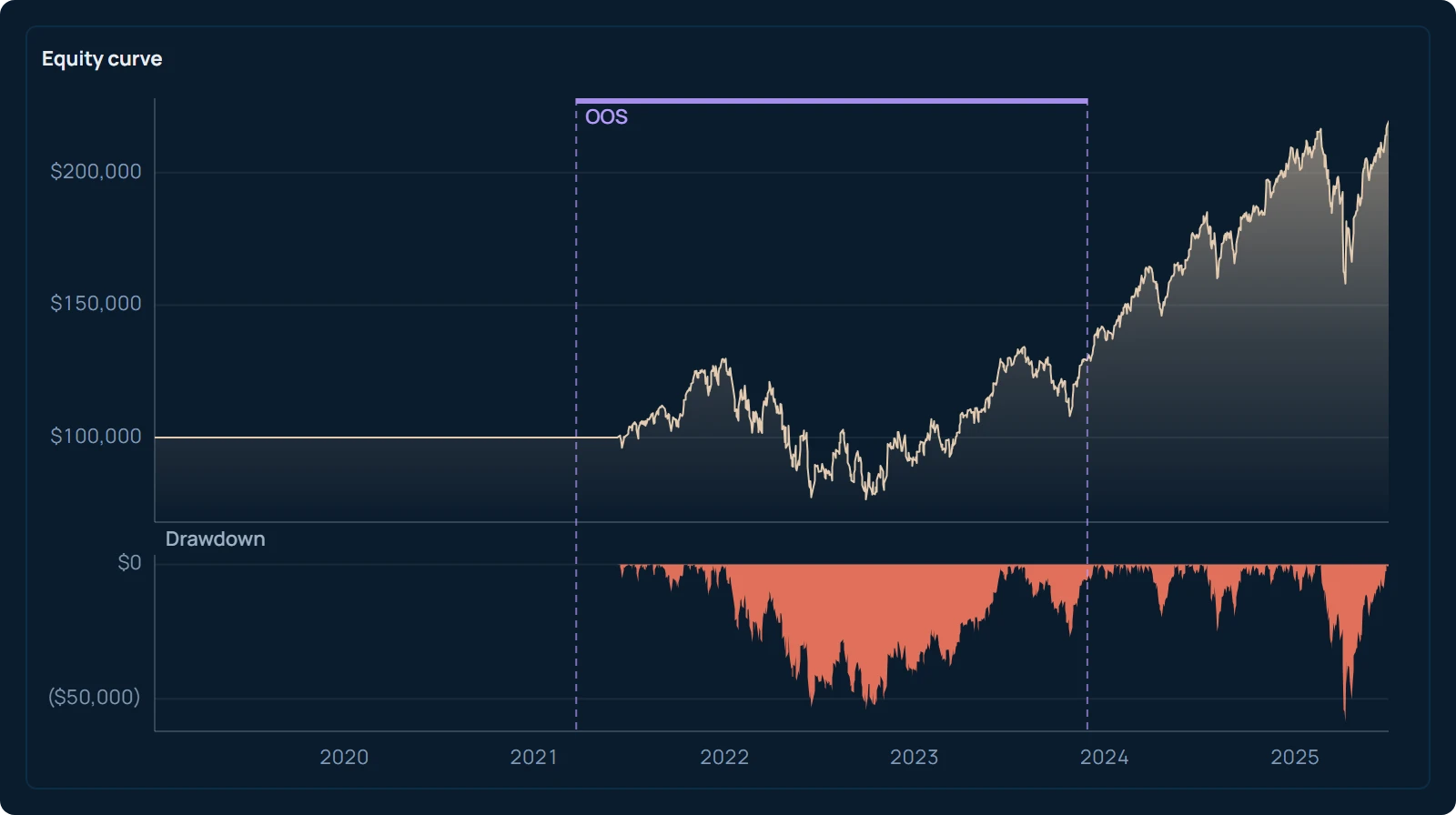
Read the report as a chain: 68 trades, each measured in ticks, each tick turned into dollars by the contract setting, then summed into the equity curve, the max drawdown of $68,007.5 and the average trade of $1,506.47. In the Performance Report of AlphaPrime, the equity, drawdown, trade and long-and-short pages all inherit the point value you entered for the contract, so an MGC test with the wrong point value is wrong on every page at once, and a correct one lets you read the average trade directly against your commission and slippage per contract.
Before your next MGC test, open the exchange's contract page, confirm 10 troy ounces and a $0.10 tick, enter $10 per point in your backtest settings, and multiply your planned stop in ticks by $1 to see the risk per contract.
Frequently asked questions
How much is one tick of MGC worth?
One MGC tick is worth $1.00. The tick size is $0.10 per troy ounce and the contract covers 10 troy ounces, so 10 × $0.10 = $1.00. A $1.00 move in the gold price is 10 ticks, or $10 per contract.
How much is one tick on GC, and how does the micro compare?
One GC tick is worth $10, because the full-size gold contract covers 100 troy ounces and the tick is $0.10 per ounce. The micro contract, MGC, has the same tick size on 10 ounces, so its tick is worth $1. Ten MGC contracts match the exposure of one GC.
What is the MGC contract specification?
MGC is the Micro Gold future on COMEX, part of CME Group. It covers 10 troy ounces of gold, is quoted in US dollars per troy ounce, moves in $0.10 ticks worth $1.00, and trades on CME Globex from Sunday evening to Friday afternoon Chicago time with a daily one-hour break. Exchanges can change these values, so confirm them on the exchange's contract page.
Can I backtest a GC strategy and trade it on MGC?
The price series and tick size are the same, so the signals and the stop distances in ticks carry over. The dollar figures do not: set the point value to $10 for MGC instead of $100 for GC, and enter the commission per MGC contract, which is charged per contract. Rerun the test with the MGC settings rather than dividing the GC report by ten.
References
- Bailey, D. H., Borwein, J., López de Prado, M., & Zhu, Q. J. (2014). Pseudo-Mathematics and Financial Charlatanism: The Effects of Backtest Overfitting on Out-of-Sample Performance. Notices of the American Mathematical Society, 61(5), 458–471.
- Harvey, C. R., & Liu, Y. (2015). Backtesting. The Journal of Portfolio Management, 42(1), 13–28.