

Backtesting TAIEX futures: five settings to check first
A TAIEX futures backtest that does not match live fills is often not a logic problem. The backtest assumptions differ from live trading conditions. Settle these five before the first run.
AlphaPrime team ·
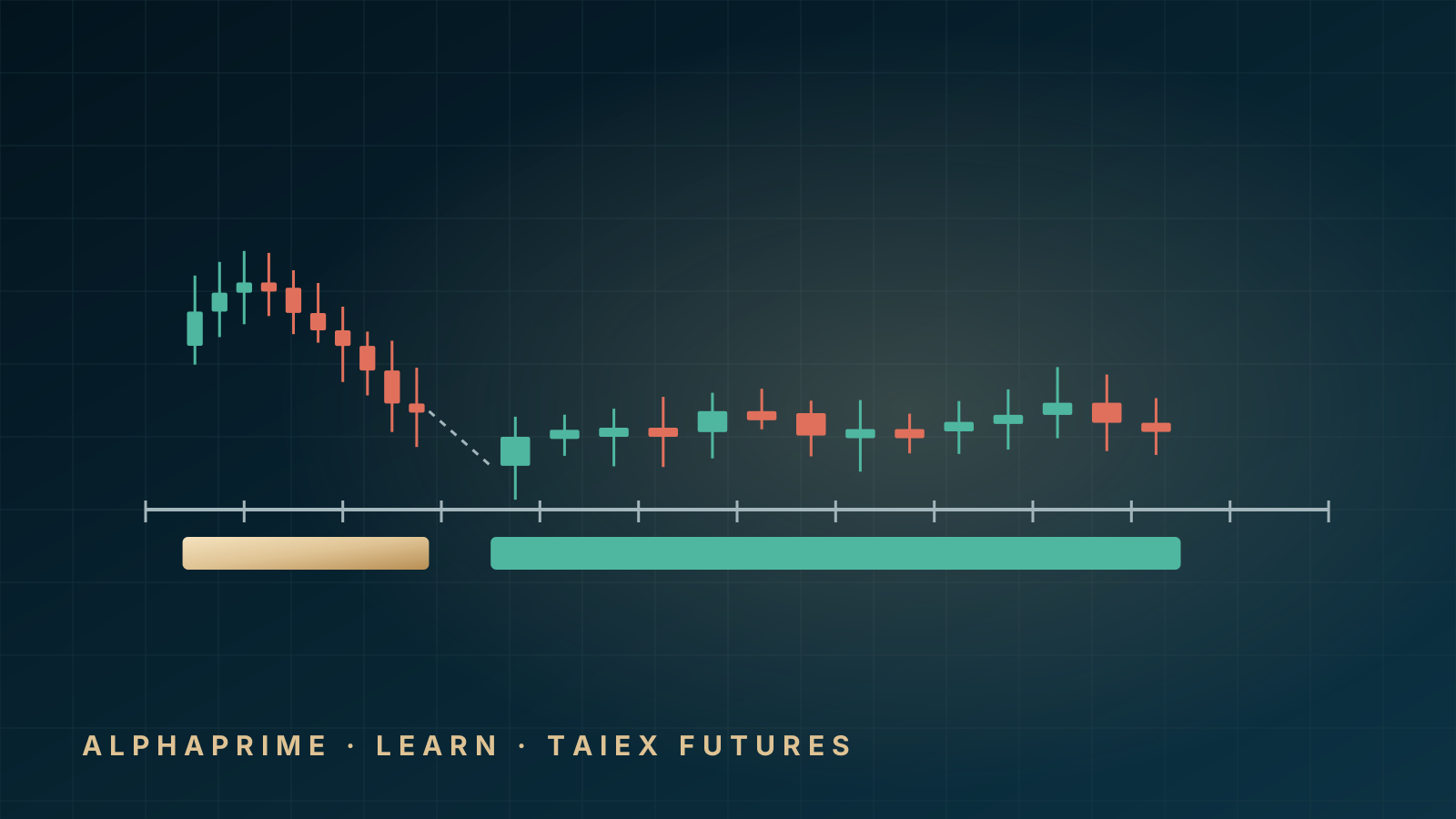
1. Session: day only, or day plus night
TAIEX futures (TX) trade a regular session from 8:45 a.m. to 1:45 p.m. Taiwan time and an after-hours session from 3:00 p.m. to 5:00 a.m. Intraday bars inside the day session do not change, but daily bars, the opening gap and look-back indicators such as moving averages and ATR take different values depending on whether night-session bars are included.
Use the same session template in research as on the live MultiCharts chart. A session mismatch between the two is one of the most common reasons a backtest and live trading disagree.
2. Final settlement and the roll
TAIEX futures stop trading on the third Wednesday of the delivery month. On that day the expiring contract closes at 1:30 p.m. and has no after-hours session; the next month trades its normal hours.
Long backtests usually run on front-month continuous data (often quoted as TXF1). The price difference between the old and new contract at the roll is not strategy P&L. Check on which day your data rolls, whether that difference has been adjusted, and whether the strategy should avoid new entries on settlement day.
3. Point values: TX and MTX
The full-size contract (TX, commonly TXF in MultiCharts) is NT$200 per index point; the mini (MTX, commonly MXF) is NT$50. The same strategy on the other contract makes the same number of points with a 4:1 difference in money, and the share of P&L taken by costs changes with it.
When switching between the two, change the point value and the per-contract costs together, and check that P&L is calculated with the correct point value.
4. Costs: commission plus transaction tax
Taiwan's futures transaction tax is the contract value times the tax rate, and the rate for TAIEX futures is 0.002% (2 in 100,000). With the index at 20,000, one TX contract is worth 20,000 × NT$200 = NT$4 million, so the tax is about NT$80 per side. Commission depends on your broker. Both are charged on entry and on exit.
The more often a strategy trades, the more these costs eat into the result. See trading costs in backtests for how to model them.
5. Slippage
The tick size is one index point. Market and stop orders often fill away from the signal price, so start with one to three ticks per side (NT$200 a tick on TX, NT$50 on MTX). Slippage is usually larger at the open and around major data releases. A strategy that only works at zero slippage has an edge thinner than its costs.
What AlphaPrime does here
AlphaPrime includes the point values, day and night sessions and default costs for TX and MTX. You can change commission and slippage to your futures broker’s actual figures, and the software remembers them per instrument. Historical data can be updated in the software’s Market Data library for research and backtesting within AlphaPrime; you can also import your own bar files. Strategies you keep can be exported as PowerLanguage and compiled in MultiCharts; before the first time, import the AlphaPrime function library into MultiCharts once.